


Peng Zhengfeng, Chairman of the Board of Ruifeng Holding Group, attended the 2026 China International Fair for Trade in Services (CIFTIS)
#Company news ·2026-09-17 10:55:13


From September 9th to 13th, the 2026 China International Fair for Trade in Services (CIFTIS) was held at the Shougang Park in Beijing. As an important platform for China to expand high-level opening-up and deepen innovative cooperation in trade in services, this edition of CIFTIS gathered global government agencies, international organizations, industry leaders, and experts and scholars to discuss new trends and opportunities in the development of trade in services.
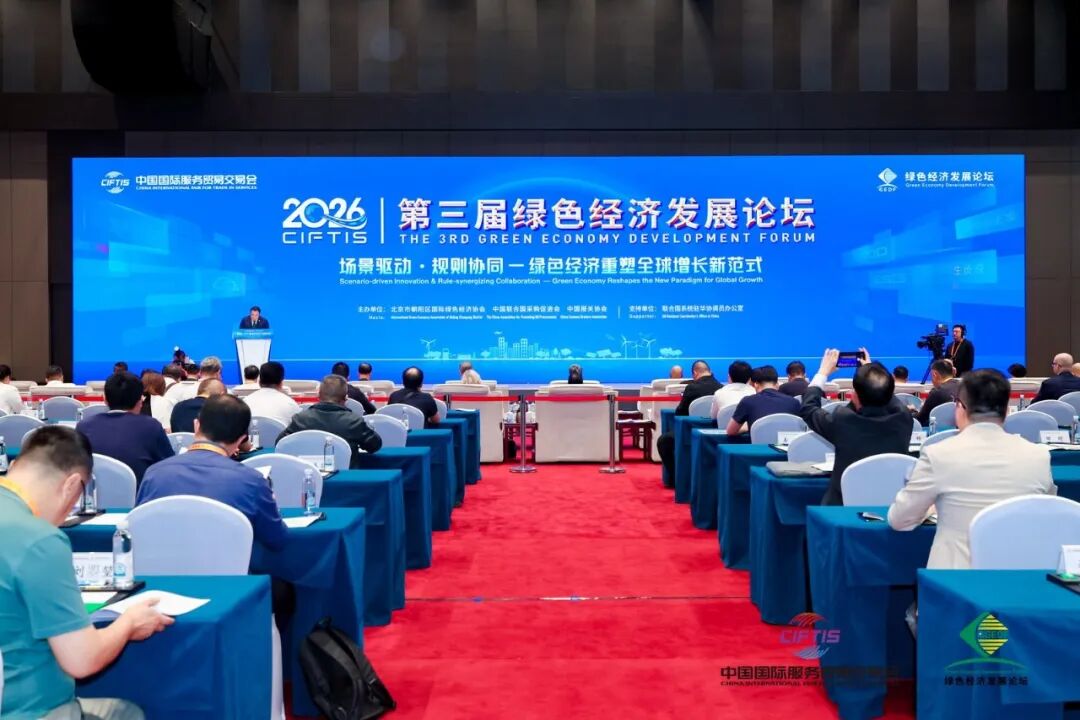
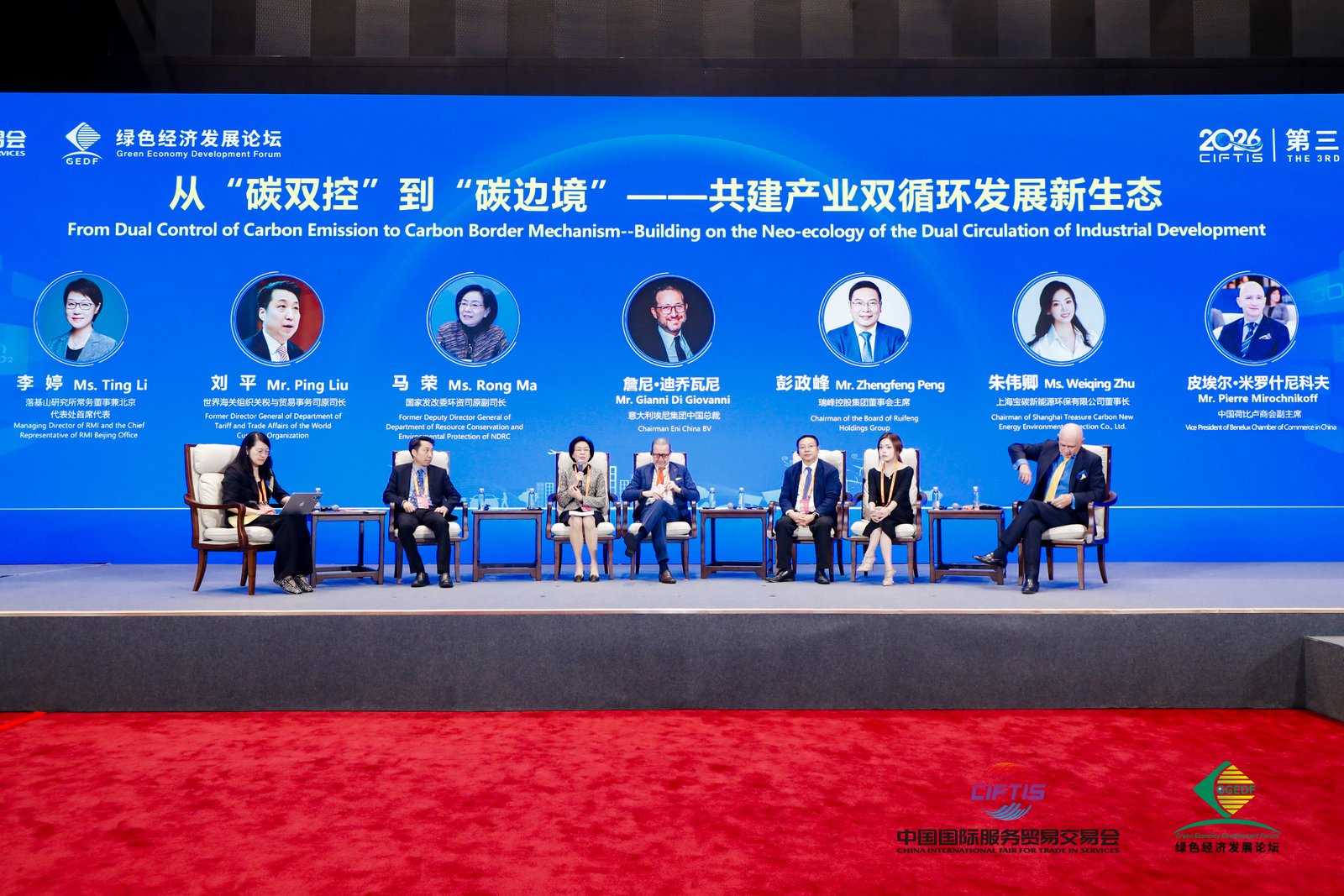
On September 11, the 2026 CIFTIS Green Development Sector Theme Forum - the Third Green Economic Development Forum was held at the Shougang International Convention and Exhibition Center. Peng Zhengfeng, Vice Chairman of the Green Investment Committee of the International Green Economy Association and Chairman of the Board of Ruifeng Holding Group, was invited to attend the high-end dialogue titled "From 'Carbon Dual Control' to 'Carbon Border' - Building a New Ecosystem for Dual Circulation Development of Industries". He engaged in discussions with Chinese and foreign guests from policy research, international organizations, multinational enterprises, international chambers of commerce, and the green industry sector, focusing on industrial opportunities, corporate responses, and international collaboration in the context of the reshaping of global green economic and trade rules.
During the forum, Ruifeng Holding's green and low-carbon technology practices were simultaneously selected as typical cases of "seeing" new paradigms of green economy at the 3rd Green Economic Development Forum, and were awarded as "typical cases of green AI and dual-carbon emission reduction technology".
Discussing the New Paradigm of Global Green Economy
Themed "Scenario-Driven, Rule-Synergized - Green Economy Reshaping the New Paradigm of Global Growth", this year's Green Economy Development Forum focused on China's "14th Five-Year Plan" carbon emission dual-control policy and international high-standard green economic and trade rules, attracting over 400 guests including officials from the United Nations, the European Union, and the League of Arab States in China, diplomatic envoys from multiple countries in China, domestic ministry experts, academicians of the Chinese Academy of Sciences and Chinese Academy of Engineering, and representatives of leading enterprises in the green and low-carbon fields.
In the high-end dialogue, Peng Zhengfeng participated in discussions with Liu Ping, former Director of the Tariff and Trade Affairs Department of the World Customs Organization; Ma Rong, former Deputy Director of the Environment and Resources Department of the National Development and Reform Commission; Li Ting, Managing Director and Chief Representative of the Beijing Representative Office of the Rocky Mountain Institute; Gianni Di Giovanni, President of Eni China; Pierre Miroshnikov, Vice Chairman of the Benelux Chamber of Commerce in China; and Zhu Weiqing, Chairman of Shanghai Baotan New Energy Environmental Protection Co., Ltd.
With the continuous improvement of domestic carbon emission management systems and the evolving international green regulations such as the EU Carbon Border Adjustment Mechanism (CBAM), carbon constraints are extending from the production side to the trade side, supply chain side, and the entire product lifecycle. Green and low-carbon capabilities are increasingly becoming an important fundamental ability for enterprises to participate in global industrial competition.
Reduce the "green premium" and make green a market choice
During the thematic dialogue, Peng Zhengfeng delved into the "green premium" analytical framework proposed in "The Economics of Carbon Neutrality" and shared his observations on the global green transformation path.
He stated that the core of truly achieving scale and marketization in green transformation lies in continuously narrowing the cost difference between clean energy and traditional fossil fuels. Ultimately, through technological innovation, industrial investment, and economies of scale, green choices will become more economically viable.
From global practices, one approach involves increasing the cost of traditional high-carbon energy through carbon pricing mechanisms such as carbon markets and carbon taxes; the other approach involves continuously reducing the cost of new energy through green investment, technological innovation, and manufacturing scale effects. China's new energy industry has developed rapidly in recent years, reflecting the industrial value of the latter approach.
With the gradual implementation of green trade rules such as CBAM, enterprises are no longer solely facing competition in terms of products, prices, and efficiency in the traditional sense. Carbon emissions, product carbon footprint, green supply chain, and international compliance capabilities are emerging as new variables in global industrial competition.
Peng Zhengfeng believes that for Chinese enterprises, this brings new challenges and also breeds new industrial opportunities. Enterprises should not merely respond passively after the rules are implemented, but should incorporate carbon management and green requirements into product design, technological research and development, and industrial layout. Through technological progress, they can turn green transformation from a "cost item" into a "growth item".
From rule adaptation to industrial synergy
Facing the new global green economic and trade environment, Peng Zhengfeng proposed that Chinese and foreign enterprises can strengthen cooperation in three aspects: standard alignment, rule prioritization, and supply chain collaboration.
Firstly, we should promote the practical alignment of carbon accounting with compliance standards, strengthen the integration of product life cycle assessment (LCA), carbon footprint accounting, and data disclosure systems, enhance the compatibility of domestic carbon data with internationally accepted methodologies, and reduce the cost of repetitive accounting for enterprises.
Secondly, we should advance the research and judgment of international green rules to the R&D and manufacturing stages. By facilitating information exchange between upstream and downstream industries, we can embed overseas green indicators into product design, technology research and development, and process transformation in advance, shifting from "post-compliance" to "pre-planning".
Thirdly, we should jointly empower the green upgrading of upstream and downstream supply chains. By sharing technology, standards, tools, and experience, we can drive small and medium-sized enterprises to enhance their carbon management, data disclosure, and green production capabilities, so that the entire industry chain can simultaneously adapt to domestic carbon management and international green trade requirements.
"Through standard alignment, pre-judgment based on rules, and joint empowerment by the supply chain, Chinese and foreign enterprises can turn compliance pressure into opportunities for cooperation, and strengthen the foundation of the green industrial chain for both domestic and international cycles," said Peng Zhengfeng.
In recent years, Ruifeng Holdings has continuously invested in areas such as new energy materials, power battery recycling, semiconductor materials, and green AI infrastructure. Through global industrial resource connections, it promotes deep collaboration between technology, capital, and physical industries.
Looking ahead, Ruifeng Holdings will continue to intensify its efforts in incubating low-carbon new materials and green hard technologies, deepen cross-border cooperation in green science and innovation, promote the deep integration of international advanced technologies and standards with China's manufacturing capabilities, and facilitate the entry of more domestic low-carbon materials, green technologies, and industrial solutions into the international market.
From "carbon dual control" to "carbon border", global industrial rules are being reshaped. Ruifeng Holdings will continue to leverage technological innovation to reduce green costs and industrial synergy to amplify green value, exploring new growth opportunities in the global green industrial dual circulation.